Posts

Karak Castle & Dana Village
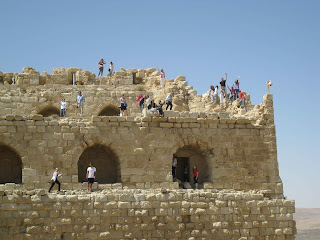
Image
Nothing beats experience.   No amount of classroom time in Boston can match putting students into a place where they can see, hear, touch, smell, taste, or otherwise acquire first-hand knowledge in the field itself.       In this picture, students were visiting Karak Castle, originally built as a Crusader castle in 1132 AD/C.E. The castle fell to Saladin’s army in 1188, after which time it took on major changes, the basic form of which we still can explore in the 21 st century.   Today, we see the differences between the rough and dark Crusader masonry and the lighter, softer limestone used by the Muslims, as well as some Ottoman additions from the late 19 th Century.   Here, our students climb up to a lookout position in the upper court.   I believe none of these students had ever explored a Crusader or a Muslim castle until this visit.   They learned from us a bit about the history of the Crusades and the Mus...

Jerash and Ajloun

Image
Today, we visited Ajloun and Jerash.  The latter is known as the 'Pompeii of the East'. Here is how our SIT hosts presented the information about both: Jerash is one of the best preserved and most complete Roman cities in the world. It was a member of the Decapolis group of cities, one of the ten biggest Roman cities. With a rich history going back several thousand years, the site is very expansive and lies in a green and fertile valley nestling in the hills of Gilead. Visitors wander among colonnaded streets, temples, theaters, plazas and baths that lie within the ancient walls. The site is breathtaking and archaeologists are still revealing more all the time. Ajloun Castle :  20 minutes drive west of Jerash.  Sitting atop a high peak is the 12th century Arab fortress of Ajloun. Visible from all directions, the castle was originally built in 1184 by a nephew of the great Arab leader Salahaddin (Saladin).  It was used as a base in his successful campaign to ...

mansaf! Dinner at Dr. Raed's home

Image
mansaf is the traditional Jordanian meal, made of lamb, cooked in a yogurt sauce and served with rice.  It usually takes hours to prepare this meal.  It is really a feast!  Dr. Raed and his wife invited all the faculty over to their home tonight; it was my first time in their home, and it was such an honor to meet his wife and his 4 children: 2 boys, and 2 girls.  The youngest, whose nickname is Nadoush, is only 2 years old yet she has the personality and "presence" of a much older girl.  She is precocious!, and precious, and smart, and so-so friendly.  She really took to Ilham.  Below is a picture of "the twins" as I call them, because of this picture.  Also below is a picture of Carlene and our host and hostess, Dr. Raed and his wife. 

Out of the woods??

Well, this is one for the record books in Dialogue History. We had a total of 8 students get sick, with 4 (or possibly 5) visits sick enough to warrant a doctor's opinion at the local medical center.  These students were suffering from some combination of food poisoning or some other bacterial yuckiness (to use the technical term).  It seems to have been a 36-hour thing, as all of them now profess to be fully or near-fully on the mend and back in good (or good enough) health. We also think that some of this may have been transferred from "the sick" to the otherwise not affected - until those healthy ones were good Samaritans (we are in the holy land after all) and only after visiting the sick students did these become sick.  So, we joked about having to "quarantine" ourselves - meaning, basically, to stay away from the sick ones for a day, until we could stop the spread.  (One "patient"/student put this word on her facebook page, and that was a ...

Badia home visits

Image
Here are a few pictures of our visit to the northern Badia of Jordan. Dr. Raed, in his white dishdasha and red&white kaffiyeh , plus Eric and Fernando in theirs. Below that, Dr. Raed and one of the "host fathers" from the home stay. And here's the whole family, outside their home, to say good-bye:

Site visits - Madaba, Mount Nebo, and Dead Sea

We've had a couple people get sick today and yesterday; IF YOUR CHILD has NOT contacted you, then rest easy - it's not your child who is sick.  Two women (both of whom contacted their parents) stayed behind from the visit to the Dead Sea.  I'm with them.  We checked them into our hotel so they could have a "5-star recovery" at the Hotel Bristol here in Amman.  The rest of the group is (as I write this) en route to the Dead Sea to float and soak up the saltiest sea on earth, in the lowest point on the planet as well.  I have some pictures of the Badia visits we made on Friday; once I get those uploaded, I'll post those. 

"The Badia" - all students in their temporary new homes

Badia is an "Arabic word used to describe arid to semi-arid regions of the Middle East where rainfall averages less than 200mm. Today, this region makes up part of Jordan, Syria, Saudi Arabia and Iraq. In Jordan, the Badia extends from north to south along the eastern portion covering about 80% of Jordan's total area. At present it is home to about only 5% of the Jordanian population." ( www.badia.gov.jo/land.html )  Go to this link and see the north Badia; that's where all the students are - in various villages across the north.  All 47 of our students arrived safe and sound in their "Badia homes", where they will stay for 2 nights and return to Amman on Saturday.  SIT leaders (Dr. Raed and Dema, both of whom are from the Badia) plus Ilham, Heather, and I will visit all the students on Friday, and meet their host families.  I'll make sure to get some good pics, as I'm sure the students will do - and will have even better pictures to share.